
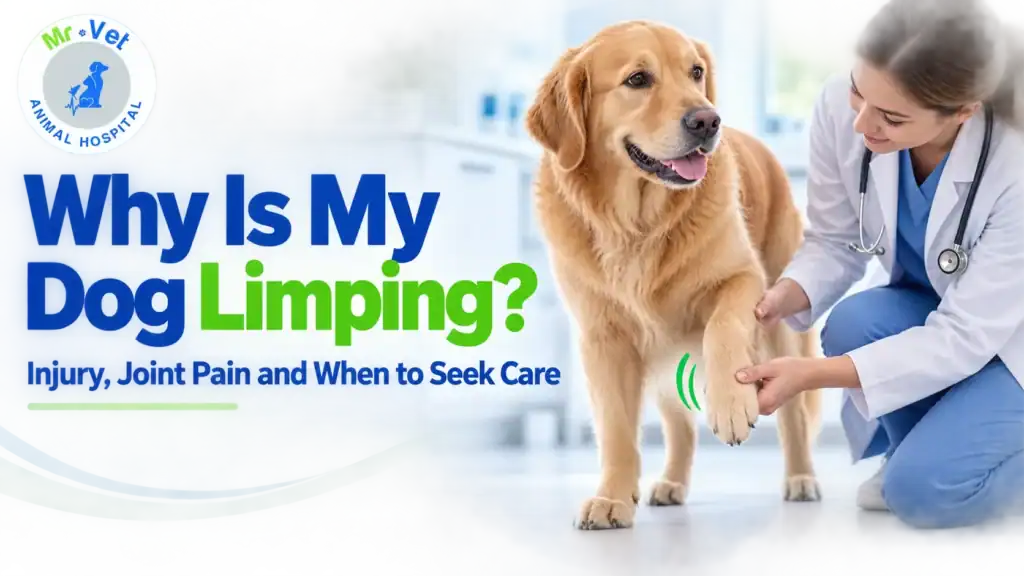
Your dog bounds out for a walk, then suddenly starts favouring one leg. You check the paw, but nothing looks wrong. Should you let them rest, or arrange a vet visit?
Thank you for reading this post, don't forget to subscribe!Limping means your dog is having trouble using a leg, but it does not tell you why. The cause may be a sore paw, a muscle strain, a ligament injury, or a joint condition. If your dog cannot stand or walk without help, has an obviously injured leg, or started limping after a serious accident, seek emergency veterinary care. A limp that persists, worsens, or keeps returning also needs a checkup.
What does a dog’s limp tell you?
A dog may hold a leg completely off the ground, take shorter steps, shift weight to another leg, or appear stiff when getting up. The limp might start suddenly after play or develop so gradually that you first notice your dog avoiding stairs.
These differences give your veterinarian useful clues, but they cannot identify the cause on their own. Pain or difficulty moving can begin in a paw, bone, muscle, tendon, ligament, joint, or nerve. Sometimes there is swelling or a wound. At other times, the leg looks normal from the outside.
Why is my dog limping?
Paw or nail problems
Think about where your dog has walked recently. A cut paw pad, torn nail, or object caught between the toes may cause a sudden limp. Your dog might lick one foot or pull away when you approach it. Paw injuries can be easy to miss beneath fur or between the toes.
If your dog is comfortable with handling, you can look for an obvious problem. Do not force an examination if they resist or seem painful.
Muscle or ligament injuries
An awkward landing or vigorous play can be followed by a limp. Some injuries improve with appropriate rest, while others affect structures that stabilise a joint and need veterinary treatment.
The cranial cruciate ligament helps stabilise a dog’s knee. Disease or tearing of this ligament is a common cause of hind-leg lameness. Signs can include difficulty rising, reluctance to jump, stiffness, or a limp that varies in severity. A dog may not cry out even when the knee is painful.
Joint conditions and arthritis
A dog that seems stiff after lying down, hesitates before climbing stairs, or walks less willingly may have joint discomfort. Osteoarthritis can cause limping and reduced mobility over time. Hip problems can also affect how a dog walks.
These conditions can occur alongside an injury. An older dog’s new limp should not automatically be dismissed as a normal part of ageing.
Fractures, dislocations, and other conditions
After a fall, collision, or other accident, limping may indicate a fracture or dislocated joint. A swollen, painful joint accompanied by fever or loss of appetite can suggest another condition that also needs prompt assessment. Your veterinarian’s examination helps narrow down the cause.
Does it matter which leg is limping?
Yes, but locating the affected leg can be harder than it sounds. A front-leg limp may show as an uneven stride or head movement. A hind-leg problem may look like skipping, shortened steps, or reluctance to push off. If more than one leg hurts, your dog might simply move slowly or seem generally stiff.
Watch your dog walk on a level surface without encouraging them to run. A short video of the limp can be helpful at the appointment, especially if the problem is most noticeable when your dog gets up after resting. Note when the limp began and whether it changes after exercise.
What can I safely do at home?
Reduce your dog’s activity while you arrange advice. Avoid running, jumping, rough play, and long walks. Keep necessary trips outside brief and controlled.
If your dog is calm and willing, gently look at the paw and nail for a visible injury or something caught between the toes. Stop if your dog pulls away, cries, growls, or appears distressed. Do not bend a painful joint to test it, attempt to straighten a leg, or try to make your dog walk normally.
Do not give human pain medicines such as ibuprofen, naproxen, or paracetamol without veterinary direction. Medicines used by people may harm dogs, and the right pain relief depends on your dog’s health and the cause of the limp.
When should a limping dog see a vet?
Seek emergency care now
Go to an emergency veterinary service if your dog:
- Cannot stand or walk without assistance.
- Has an obviously fractured or unusually angled leg.
- Started limping after being hit by a vehicle or another major injury.
- Has severe pain or appears seriously unwell.
Limit movement while you arrange transport. If your dog cannot walk, call the veterinary service for advice on moving them safely.
Arrange a prompt veterinary assessment
Contact a vet if your dog will not put weight on a leg, the limp is getting worse, you notice swelling or a wound, or your dog seems painful. Seek advice if a mild limp persists or keeps returning.
Be especially attentive with puppies. A puppy’s limp may result from an injury or a growth-related condition, and an examination can help distinguish between them.
How will the vet find the cause?
Your veterinarian will ask when the limp began, whether your dog had an accident, which leg seems affected, and whether the problem changes after rest or activity. They may watch your dog stand, get up, and walk before examining the paws, muscles, bones, and joints.
The examination can reveal pain, swelling, reduced movement, or joint instability. Depending on those findings, the vet may recommend X-rays or other tests. An X-ray can help assess bones and joint changes, but it does not directly show every soft tissue injury.
What treatment might my dog need?
Treatment depends on the diagnosis. A paw injury may need wound care. A soft tissue injury may require restricted activity and a plan for gradually returning to exercise. Your vet may prescribe pain relief suited to your dog and explain what changes to watch for.
Joint disease may need longer-term management, including weight control, suitable activity, medication, or rehabilitation. Some fractures and ligament injuries need surgery. For a knee ligament injury, pain medicine may improve comfort, but it cannot by itself correct an unstable joint. Your veterinarian can explain the options after examining your dog.
Can limping be prevented?
No routine can prevent every accident, but sensible habits may reduce some risks. Keep your dog at a healthy weight, build exercise gradually, and follow any activity limits advised for a known joint problem. Check paws and nails regularly, particularly after walks on rough ground.
If your dog has been treated for an injury, follow the recovery plan even when they begin to look comfortable. Returning to vigorous activity too soon may interrupt healing.
If your dog is limping, contact Mr. Vet Hospitals in Hyderabad to arrange an assessment. Explain when the limp started and whether your dog can put weight on the leg. If your dog cannot stand, has an obvious fracture, or has suffered major trauma, seek emergency veterinary care.
FAQs:
My dog is limping but not crying. Could they still be in pain?
Yes. Dogs do not always make noise when something hurts. A persistent change in the way your dog walks can itself be a sign of pain.
Why does my dog limp after sleeping?
Stiffness after rest can occur with joint problems, including arthritis or a knee ligament condition. Tell your vet whether your dog moves more easily after a few steps or remains lame.
Should I walk my dog if they are limping?
Skip exercise walks, running, and jumping until you have veterinary advice. Keep essential movement brief and controlled, and seek care promptly if your dog struggles to walk.
Can a limp go away on its own?
A brief, mild limp may settle, but improvement does not always reveal the cause. Arrange an examination if it persists, worsens, or comes back.
Why is my dog limping on a back leg?
Possible causes range from a paw injury to knee or hip disease. Your vet must examine your dog to determine where the problem starts and what treatment is needed.
Can I give my dog a painkiller before the appointment?
Speak with a veterinarian first. Human painkillers can harm dogs, and even a medicine previously prescribed for your pet may be unsuitable for a new problem.